60 CHECKS · 17 FAMILIES · ONE AUDIT CHAIN

Your AI wrote it.
We breach-check it.

VibeGuard attacks the sites, apps, repos, and hosts you vibe-coded — the way an attacker would. Leaked LLM keys, open database permissions, backdoor admin logins. Then it hands you the exact fix, in your stack's language — and verifies your fix didn't break anything else.

Scan my site free →▶ Enter live demo
60
checks / scan
4
modules
<60s
median scan
100%
audit-chained
vibeguard@ops:~ — live breach-check0/100 F
SYS$ vibeguard scan https://your-ai-app.com
SYSownership verified · token found (meta tag)
SYSauthorization signed · scope locked · budget 300 req
CRITSupabase 'users' readable anonymously (RLS off)
CRITSupabase service_role JWT shipped in client bundle
CRITDefault credentials accepted at /admin/login
CRIT/.env deployed to web root
CRITVerbose stack trace at /api/users/999
HIGHOpenAI project key in client bundle — sk-proj-VgFx…
PASS13 checks clean · unknown reported as unknown
SYS47 findings · 0/100 (F) · fix guidance ready
SYSaudit chain appended · seq 0001 → 0002 → 0003 ✓
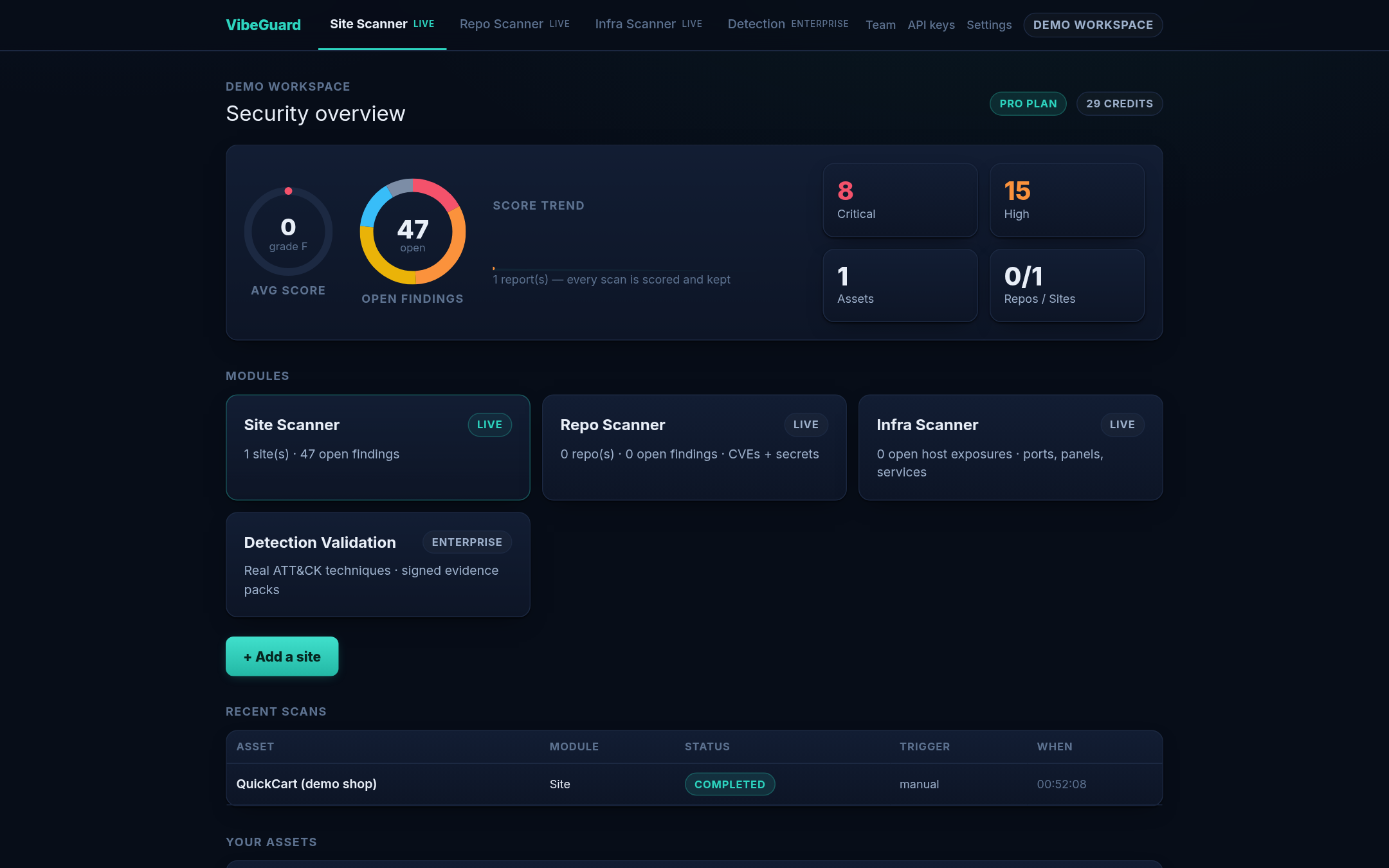
01The product — live dashboard
vibeguard.simoncallaghan.dev/app
VibeGuard dashboard — vulnerability score, severity breakdown and findings for the demo shop
02What your AI ships broken — the failure gallery

Every card below is a check that runs on every scan — a failure pattern AI-generated code ships again and again. Each one ships with evidence, the fix in your stack's language, and a free rescan that proves the fix held.

CRITICALbaas

Supabase table readable without authentication

GET /rest/v1/users?select=* → 200 · 4,213 rows

- const { data } = await supabase.from('users').select('*');
+ -- enable RLS, then grant by uid:
+ create policy "own rows" on users
+   for select using (auth.uid() = id);
SupabasePostgREST
fix included
CRITICALauth

Default credentials grant admin access

POST /admin/login [email protected] : admin123 → 302 /admin

Seed logins survive every launch. We try the top 10k pairs — only after ownership is proven.

any stack
fix included
HIGHsecrets

LLM provider key shipped in the client bundle

sk-proj-VgFx… extracted from /_next/static/chunks/app.js

- const openai = new OpenAI({ apiKey: process.env.NEXT_PUBLIC_OPENAI_KEY });
+ // server route only — the key never crosses the wire:
+ export async function POST() {
+   const openai = new OpenAI(); // reads server-side env
+ }
OpenAINext.js
fix included
HIGHsecrets

.git directory deployed to the web root

GET /.git/HEAD → 200 · ref: refs/heads/main

Full source history is one `git clone` away from anyone who notices the path.

any deploy
fix included
HIGHbaas

Firebase Realtime Database readable anonymously

GET https://demo.firebaseio.com/rest?shallow=true → 200

Firebase
fix included
HIGHauth

No rate limiting on the login endpoint

8 failed logins · 150ms apart · zero 429s

Credential stuffing doesn't need skill — it needs an unthrottled endpoint.

ExpressNext.js
fix included
MEDIUMheaders

Content-Security-Policy missing

no CSP header · one XSS = full account takeover

any stack
fix included
MEDIUMsecrets

.env file deployed alongside the app

GET /.env → 200 · DATABASE_URL=postgres://…

DockerVercel
fix included
MEDIUMapp

Verbose stack traces leak framework internals

GET /api/users/999 → Prisma error + file paths in response

PrismaExpress
fix included
LOWsecrets

Source maps shipped to production

GET /js/app.js.map → 200 · original TypeScript included

Reconnaissance becomes free: original file names, routes and logic.

Next.jsVite
fix included
INFOsite

No security.txt (RFC 9116)

/.well-known/security.txt → 404

Researchers who find something have no way to reach you — so they post it elsewhere.

any domain
fix included
INFOverdicts

“Unknown” is an answer, not a failure

checks that can't complete report unknown — never pass

The false green is structural: we can't mark a check clean we didn't complete. Most scanners can — and do.

attest core
fix included
03The catalog — every family, every scan
Check catalog · 60 checks · 17 familiesmax-risk ceilings per plan · agency tier unlocks auth-active probes
App surface9
panels, debug, CSRF, XSS, redirects
Secrets6
bundles, .env, .git, dumps, maps
Headers & CSP6
CSP, HSTS, frame, sniffing
Auth & access5
seed creds, throttling, MFA
Privacy4
trackers, consent, PII, policies
BaaS config4
Supabase, Firebase panels/RLS
DNS trust3
SPF, DMARC, CAA
Transport3
TLS, cookies, cert horizon
SQL injection3
error, boolean, time-based
AI surface3
vector DBs, MCP, agents
Site hygiene3
emails, buckets, security.txt
Stability3
redirects, render-block, weight
AEO2
llms.txt, AI-crawler posture
SEO2
basics, sitemap
Path traversal1
…/…/…/etc/passwd
Command injection1
echo canary
Template injection1
SSTI canaries
Plus the repo module (OSV advisories, committed secrets, SAST rules, git-history sweep) and the infra module (19 ports classified) — same authorization gate, same audit chain.
04Four modules · one platform
05The loop
01
PROVE & AUTHORIZE

Paste a URL, verify ownership — meta tag, DNS TXT, or well-known file. You receive a signed authorization record: exact scope, probe ceilings, hours. Refusal is programmatic, not a promise.

02
BREACH-CHECK

60 checks across secrets, headers, auth, BaaS permissions, DNS trust and the AI surface. Every probe budgeted and audit-chained. Unknown is reported as unknown — the false green is structurally impossible.

03
FIX & VERIFY

Copy-paste fix in your stack's language. Hit verify: a free rescan confirms closure and sweeps upstream/downstream for regressions before the badge turns green.

06Evidence you can hand to a customer
Tamper-evident audit chain
seq 0002scan.completedsha a3f9e1…c41b
seq 0003finding.opensha 7be104…9d2f
seq 0004fix.verifiedsha c04d77…1a8e
chain verifiedsha256-linked

Every privileged action appends a hash-linked record. Nightly verification proves the chain still holds — a doctored finding breaks the math.

The false-green problem

A fix that failed looks identical, in most reports, to one that worked. “No issues found” and “we never actually checked” are the same sentence in every scanner you've used.

Our verdict engine — built on the attest detection-validation core — makes unknown a first-class answer, and allowed requires affirmative evidence on three independent sides. Run the interactive false-green demo and watch it happen.

07Sample report — first scan of the demo shop
0grade F47open
QuickCart — demo shop
60 checks · 47 findings · built to fail
Score trend: 0 → 0 → 0 → ↑ when you fix
CRITICAL Supabase table 'profiles' readable without authentication
RLS policy missing — anyone can read every row
CRITICAL Default credentials grant admin access
[email protected] / admin123 accepted at /admin/login
HIGH OpenAI project key shipped in client bundle
Extracted from /js/app.js — anyone can spend your tokens
HIGH Exposed .git directory — full source history downloadable
/.git/HEAD returns 200 with branch ref
+ 43 more in the live demo → every one with a copy-paste fix
08How we compare
VibeGuardGeneric scannersPentest reportAI chat wrapper
Finds AI-code failure patterns✓ purpose-built✗ generic✗ manual~
Plain-English per-stack fixes✓ copy-paste✗ CVE jargon✗ report PDF✗ chat output
Fix verified by re-scan✓ free rescan✗~ re-run manually✗
Signed authorization + audit chain✓ tamper-evident~✗✗
Upstream/downstream fix impact✓ dependency-aware✗✗✗
No security team required✓~✗ needs pro✗
09Pricing — free forever, pay for scale
FREE£0
1 site · weekly
all 60 checks, forever
PRO£29
5 sites · daily
PDF reports · repo scanner
TEAM£79
25 sites · hourly
public API · 10 seats
AGENCY£179
100 sites · hourly
infra scanner · 25 seats
Every tier runs the same 60-check engine with signed authorization and the tamper-evident audit chain. Full comparison →
10Frequent questions
Is the demo safe to run?

Yes. The demo target is an intentionally vulnerable app we built ourselves. The scanner only probes targets whose ownership was cryptographically verified, every probe is rate-limited and logged to a tamper-evident audit chain, and refusals are enforced in code.

What does it check that generic scanners don't?

The failure patterns AI-generated code actually ships: LLM and service keys in client bundles, Supabase/Firebase permissions left in dev mode, default seed credentials like admin123, missing ownership checks on API routes, exposed MCP and AI agent endpoints, and lockfile drift.

How do you know I own the site?

Three verification methods: a meta tag, a DNS TXT record, or a well-known file. Until one passes, zero active probes touch your site — refusal is enforced in code, and every attempt is recorded.

What happens when I fix something?

Hit 'I fixed it — verify'. A free rescan re-runs the relevant checks; the badge flips to verified-fixed only when they pass. We also check upstream and downstream for regressions the fix may have introduced — a fix that breaks something else can't slip through as clean.

What's 'unknown' in my report?

Honesty. When a check couldn't complete — the target didn't respond, a probe was out of scope — we report unknown, never pass. Most scanners launder 'didn't check' into 'all clear'. We don't.

Do you store my findings forever?

You control it. Raw evidence auto-expires, everything is exportable as JSON at any time, and deletion requests cascade immediately. The audit chain retains tamper-proof records with your identity pseudonymized.

11Built for the stack you vibe-coded with
Next.jsSupabaseFirebaseExpressVercelNetlifyCloudflareDockerPrismaDrizzleOpenAIAnthropic

We built our demo shop to fail: 47 vulnerabilities in one scan.

Yours wasn't built to fail — but if your AI wrote it, the same findings are probably hiding in it. One free scan tells you.

SCANNER OPERATIONAL · AUDIT CHAIN INTACT · NO AGENT, NO CREDENTIALS